




Laser Assisted Cataract Surgery
Laser-Assisted vs. Traditional Cataract Surgery: What Patients Should Know
Some cataract surgery marketing uses terms such as “bladeless” or “blade-free.” These terms can be confusing. Laser-assisted cataract surgery uses a femtosecond laser for selected steps of the procedure, such as creating corneal incisions, opening the front capsule of the lens, or softening the cataract.
However, the laser does not remove the cataract. That requires phacoemulsification, where a microscopic vibrating tubular blade breaks up the cataract. In addition, the laser-created incisions frequently still require completion by the surgeon using microsurgical instruments. In other words, cataract removal still requires phacoemulsification, surgeon skill, and careful judgment inside the eye.
Modern traditional phacoemulsification remains an excellent, safe, evidence-based approach. Large randomized studies have not shown a consistent clinically meaningful visual advantage of laser-assisted cataract surgery over traditional cataract surgery for most patients.
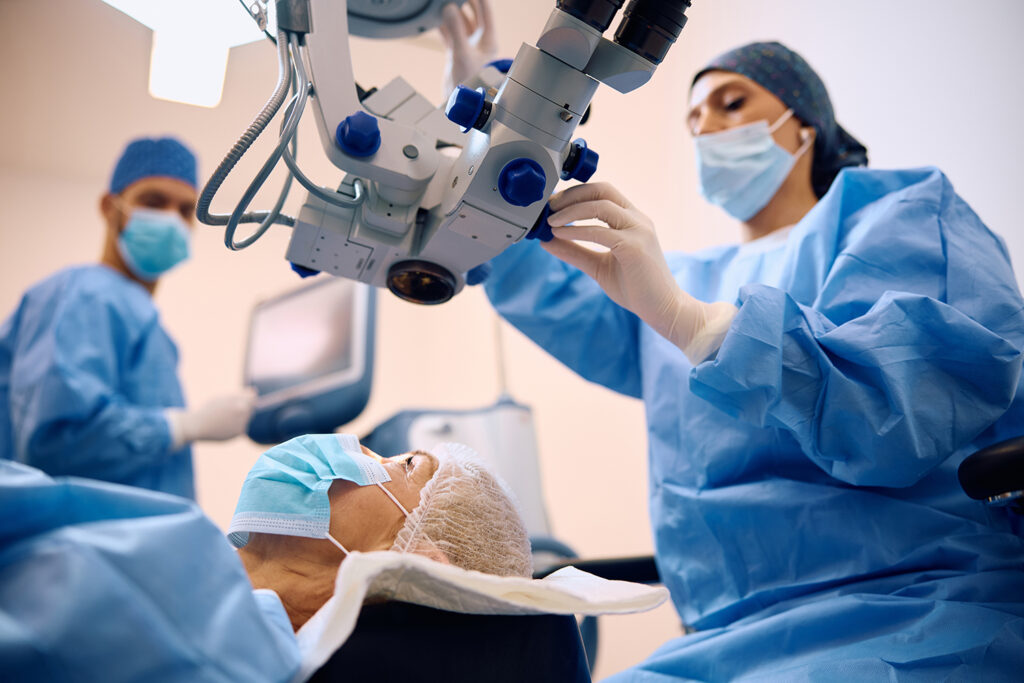
At Florida Vision Centers, a specific technology is recommended only when it is likely to improve the patient’s outcome — not simply because it is newer, more heavily marketed, or more expensive.
When advising patients — including members of my own family — I recommend the approach that is safest, most evidence-based, and best suited to that individual eye.
For decades, opening the front capsule of the cataract has been safely and reliably performed with a manual capsulorhexis using microsurgical instruments. So, why use a laser? Is it better, safer? The large randomized clinical published studies have not shown a consistent, clinically meaningful advantage of laser-assisted cataract surgery over the traditional cataract surgery. The laser capsulotomy is created by many closely spaced laser pulses. Some laboratory and clinical studies have raised questions about edge quality and tear resistance.
The relevant question is not whether a technology is newer, but whether it meaningfully benefits the patient.
I have read that laser assisted cataract surgery is more precise. Is it true?
It is true that an opening in the lens capsule made by a laser is a geometric circle. However, it is also true that a perfectly circular opening in the lens capsule is not needed for a perfect visual outcome. The lens implant (IOL) centers itself by its side arms called haptics, pushing against the periphery of the capsular bag. The central opening in a capsular bag (aka capsulotomy) plays very little role in IOL centration.
Is laser good for anything in cataract surgery?
Yes, laser is excellent and more precise than a blade in making astigmatism-reducing cuts in a cornea. This is best performed eight to twelve weeks after cataract removal and lens implantation when the residual astigmatism can be accurately measured. In the first several weeks after cataract surgery, IOL very slowly shifts within a capsular bag and cornea heals, causing the eye’s optical state to change. In addition, the brain adapts to a new lens implant and this visual perception process varies from person to person. These changes mostly stop eight weeks after surgery, revealing any residual astigmatism. This two stage method of initial cataract surgery with lens implantation followed by laser refinement achieves the best possible visual outcome.